

Do I need a blower door test for a home energy audit? Not necessarily. Air movement is measured in Cubic Feet per Minute (CFM) and a typical blower door will on average move about 3,500 CFM. Simplified, that means for a home that is 3500 Sq Ft. each and every full minute the blower door test is in operation, the house replaces all its air one complete time. That is a lot of air and it has to come from somewhere. Run the test for 30 minutes and you’ve removed and replaced the air 30 times, so where did all that new air come from? Answer, any path it possibly could and because the test was so extreme, air and moisture entered from paths it normally wouldn’t under typical use. See Can Light Air Tightness below for more.
A blower door test is designed to place air movement stresses on a home which 99% of the time, the home won’t naturally be under. It does so by creating a vacuum equal to 20 MPH winds which forces air to move unnaturally through the walls of a building amplifying suspected air leaks and creating new ones drawing in moisture. Under normal use of a home, there are bathroom exhaust fans, clothes dryer and an outside vented ranges which combined, can generate about 300 to 500 CFM. A non-high efficiency furnace also consumes indoor air for heating creating additional cold air drafts. These natural sources of air movement should first be reviewed to determine if a blower door test is needed.
What is needed for a home energy audit?
- A temperature differential of eighteen (18*) or more degrees. If you’re trying to heat your home to 70*, when the outside temperatures falls below 52*, a good thermal scan can be performed.
- A qualified Infrared Certified® Thermographer to interpret the images based on the science of heat transfer and moisture movement through objects.
What is Thermography? Is the collection of heat being emitted off two or more objects with an understanding of the difference. In respect to home inspections, thermography is not the ability to look through walls, It’s the ability to see heat on the surface being transferred through a wall. Without a complete understanding of an objects emissivity, (thermal infrared energy) and reflectance (rejection of radiant energy), an incorrect interpretation could lead to waisting time and money chasing a problem that isn’t there.
A home can lose up to 50% of its heat through the walls. Traditionally people believe most home heat loss is through the ceiling because heat rises; however, in homes with correct R38 attic insulation and R13 wall insulation, your attic has three (3) times the insulation than walls and every home has more square footage of walls than ceiling. Other than can lights, ceiling fans or bathroom vents most ceilings don’t have any protrusions for air and moisture to rise through. Without an opening in the ceiling, heat and moisture are forced to transfer through the ceiling (drywall) which has an R-value of .5 and highly permeable . This physical loss of heat is called thermal bridging and is the reason why properly installed insulation will cover the IC rated can lights and rafters to a depth of 12″. Properly installed attic insulation is a first line defense in preventing mold growth in attics.
Can Light Air Tightness.
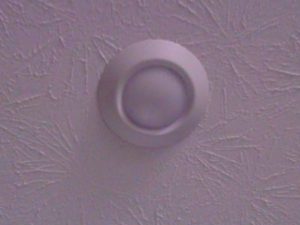
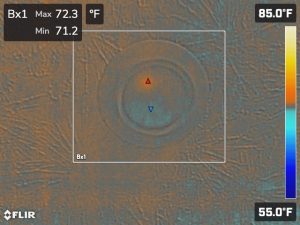
The two images below are of a IC-rated can light in a two year old home with 11′ flat ceilings. The image on the left is the visual, notice the cast shadow at the 6 o’clock position while the thermal image is on the right. In the Thermal image, the lens temperature difference between the red and blue arrows is 1.1 degrees. Due to the shadowing, this could be caused by reflected radiant temperature from the sun, it also could be an electrical component within the light. For this example it is not imperative that we know the cause as much as mentioning the understanding of minute differences. When performing thermal scans, understanding the conditions and environment are critical. Another primary focus of the thermal scan was to determine the air tightness of the IC can light. Within the white box surrounding the can light, there is no air leakage transferring humidity in or out of the room which could lead to mold growth in the attic. Other than the lens, the fixture has no thermal signature higher or lower, than the drywall.
Wood rot, Efflorescence, spalling and mold are NOT the problem, they are symptoms for the problem. Removing mold is only temporary if failure to address conditions that allow mold to grow. Call ProVim Inspections today and get pointed in the right direction.