

Why is Radon Testing important?
Radon enters buildings through cracks in foundations, slab floors, walls and any passage of air leak such as pipes and wires. Radon gas is odorless, colorless, and tasteless in water. When uranium in the soil naturally decays, radon as a radioactive gas is released. Radon gas is the number one (#1) cause of lung cancer in non-smokers.
According to Indiana law, anyone whom is performing a radon test for compensation must be certified by the Indiana State Department of Health.
Our Radon Technicians are certified through the National Radon Safety Board AND the Indiana State Department of Health.
To learn more myths and facts about Radon mitigation and Indoor Air Quality standards, Download the EPA’s free print friendly PDF guide: A Citizen’s Guide to Radon, protecting yourself and your family from Radon.
It’s never too late to reduce your risk of lung cancer. Contact ProVim Inspections and get pointed in the right direction.
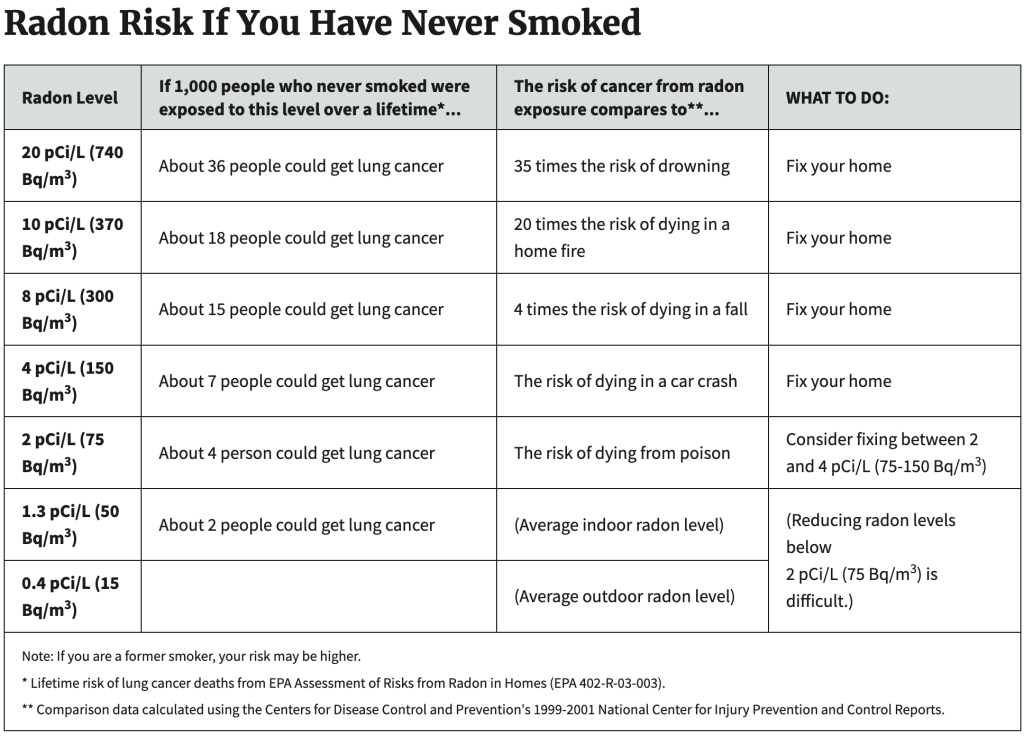
There are two time frames for testing Radon. Short term and long term. Short term Radon testing takes 48 hours of the building be “closed up” with the testing unit placed in the lowest floor, basement or crawlspace of a home. Long term Radon testing is best utilized if a short term test delivers higher than recommended levels, and will provide readings closer to a building’s annual Radon average level.
It is important to know, many weather related factors can alter the results of short term testing such as excessive rainfall, wind, barometric pressure and changes to the property which is why the EPA recommends annual testing.
We will perform the radon testing in accordance with current industry standards. We will do this by installing Radon measuring devices at the properties lowest level. These will be at the property for at least 48 hours, but possibly longer. We will then retrieve them and provide you with a written report.
The amount of radon in the air is measured in picocuries of radon gas per liter of air, or “pCi/L.” While any radon exposure creates some risk to health, the EPA considers a level of 4 pCi/L or higher dangerous and recommends that you take remedial measures to reduce the radon level.
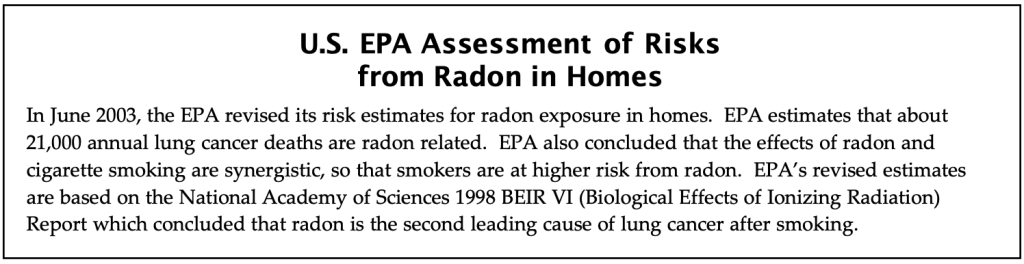
Source: Above images are provided by the EPA.