

Why is Infrared training important?
A properly trained and Certified Thermographer would be fully aware of surroundings at all times that a non-trained Contractor would miss. The accompanying image is a great example of understanding and creating ideal conditions before scanning, to limit and control situations such as solar loading.
In the top image, we can see a natural light source entering from the left as evident by the shadow markings made evenly down the register and louvered door. The right side of the register is receiving heat energy reflecting through the room, this is called reflectance. Reflected temperature is one of many parameters that need to be adjusted for, and/or controlled prior to a successful scan. reflectance on the left side, blue spot point is being blocked by the shadow of the wall allowing the left side of the register to lose or dissipate heat. It is important to remember, in the absence of heat, there is cold. Everything has temperature, even a 30* F ice cube is considerably warmer (30* warmer) than an ice cube at 0* F. In this example, the right side of the register, red spot point is 1.5* warmer simply because of reflectance or non-direct heating from the source.
Clearly this example is an extreme but it does demonstrate the power of misunderstanding outside influences. Subtle influences that thermal cameras see and the Thermal Inspector needs to fully understand. If this was a critical scan, if it was to be performed within a certain degree of accuracy (quantitative) and the numerical results were to be understood as fact. Then failure to control the environment would clearly be an oversight on the Inspector and the uneven thermal loading could be a major factor when interpreting the results.
Luckily, home energy audits are qualitative thermal scans and not quantitative scans but it is important for the Thermographer to know if the thermal anomalies are genuine or artificial.
During a thermal energy scan of a building, residential or commercial; we’re looking for elevated levels and non-uniform patterns as clues to thermal loss. Since temperature rises, we’re expecting a uniform heat signature across the entire register.
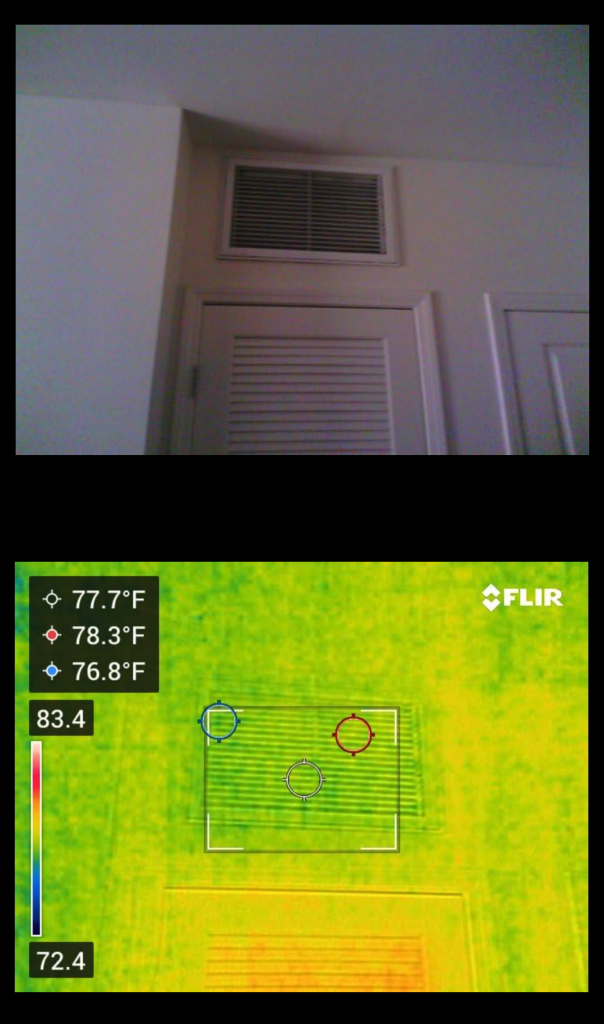
During a thermal energy scan of a building, residential or commercial; we’re looking for elevated levels and non-uniform patterns as clues to thermal loss. Since temperature rises, we’re expecting a uniform heat signature across the entire face of the register. What we have is NOT uniform and could be interpreted as a thermal anomaly and raised to the Customer as a potential problem.
Infrared Certified® Thermographers eliminate uncertainty. Get pointed in the right direction with ProVim’s ‘think thermal’ inspections.